
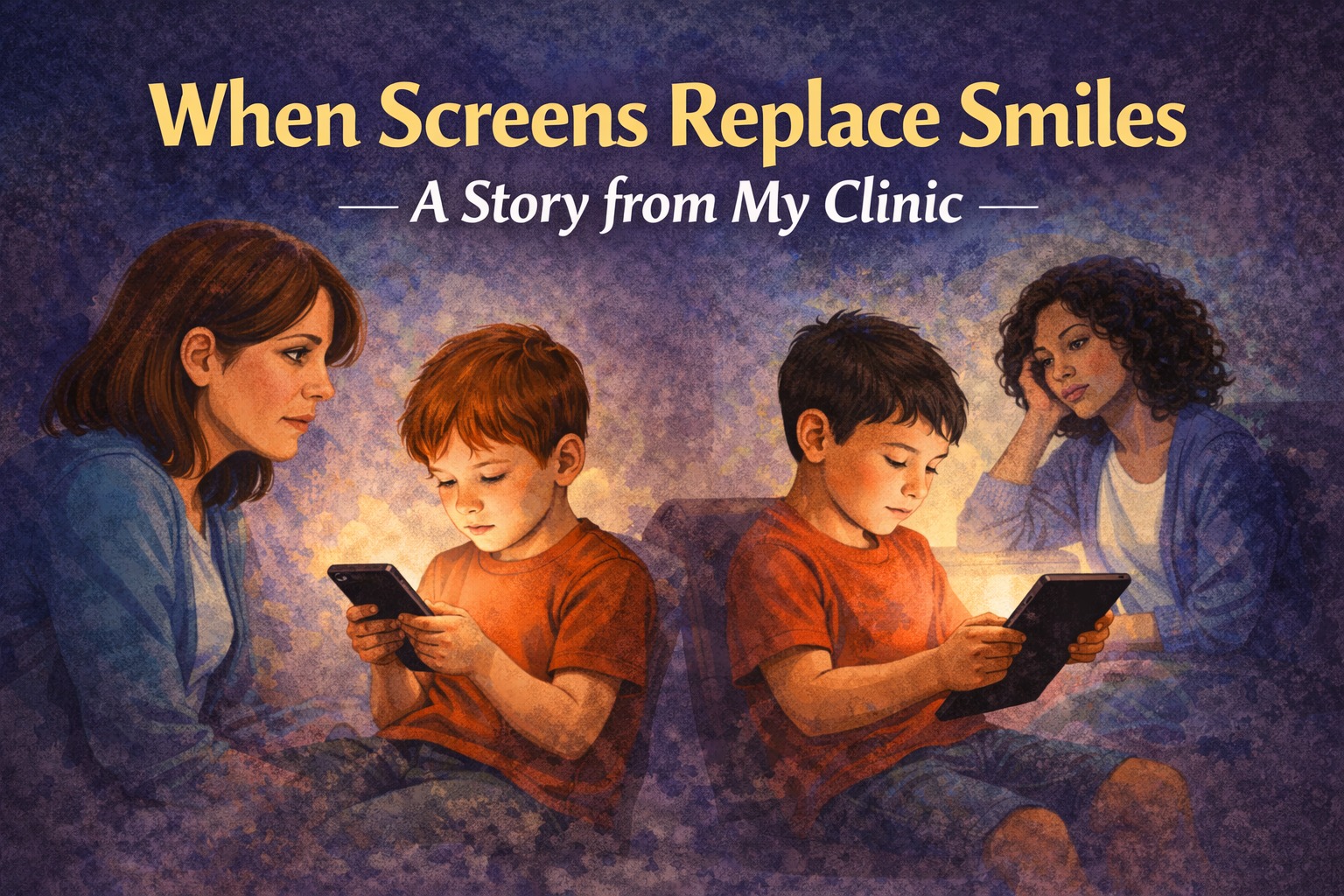
It was a regular day in the OPD.
A 4-year-old boy sat beside his mother, tugging gently at her hand.
“Amma, look!” he said, pointing to his drawing — a bright yellow sun with stick figures holding hands.
But his mother didn’t look up.
Her eyes were fixed on the phone — scrolling endlessly.
He waited.
Five minutes. Ten minutes.
Then he quietly folded the paper and whispered, “I’ll show you later.”
That moment broke my heart.
We often talk about children’s screen time, but rarely about parents’.
Research shows parents now spend 7–8 hours a day on screens, and 1 in 10 show signs of screen addiction.
It’s not just work — it’s the mindless scroll, the quick check, the endless notifications.
And while we scroll, our children wait.
They wait for connection, for eye contact, for attention — the very building blocks of emotional development.
Children mirror what they see.
If they see disconnection, they learn it.
If they see presence, they feel safe.
Let’s reclaim those moments.
Start small — just one tech-free hour a day.
No phones. No screens.
Just real conversation, laughter, and play.
Because childhood doesn’t wait — but your notifications can.
✨ Try the 1-Hour Screen-Free Rule today.
You might just rediscover the magic that was never on a screen.
- 🩺 OPD Reflection: When the Push for Independence Backfires
She sat across from me, eyes heavy with exhaustion.
“He just doesn’t settle. He cries constantly. I’ve tried everything they said — let him cry, give space, avoid too much holding… but it only made things worse.”
What she described wasn’t unfamiliar.
In recent years, there’s been a strong push toward raising “independent” babies —
Teaching “self-soothing,” discouraging responding to every cry, promoting early separation.
But what we call independence too early is often misunderstood dysregulation.
👶 Clinical Observations:
The baby showed signs of chronic stress:
🔻 Poor sleep
🔻 Heightened separation anxiety
🔻 Difficulty calming
🔻 Clinginess mislabeled as “manipulation”
And in the parent:
😞 Guilt, confusion, and emotional burnout — from trying to follow advice that didn’t feel natural, but sounded “right.”
🧠 What Neuroscience Tells Us:
📌 Babies are not born with self-regulation skills — they learn them through consistent, warm co-regulation.
📌 Crying is communication, not manipulation.
📌 Ignoring distress doesn’t build strength — it wires the brain for survival, not safety.
When left unsupported, a baby’s nervous system activates cortisol-driven stress pathways.
And what looks like “independence” may actually be emotional shutdown or hyperarousal.
This is not resilience.
It’s adaptation in the absence of connection.
💡 What Helps Instead:
As clinicians, we need to shift the narrative.
Not every cry must be “fixed,” but every distress cue deserves a response.
✨ Emotional strength is built within the safety of a relationship — not in isolation.
✨ Confidence grows not from being left alone in a crib, but from knowing someone always returns.
✨ Presence doesn’t “spoil” — it wires the brain for trust, security, and later autonomy.
We reframed the caregiving approach with:
✅ Responsive comforting
✅ Regulated routines
✅ Psychoeducation for the parent
✅ Permission to trust instinct over outdated advice
Within weeks, the shifts were undeniable:
🌙 Better sleep
🫂 Calmer transitions
😊 Secure engagement
💬 And a more confident, attuned parent-child dynamic
🔗 Final Clinical Takeaway:
You don’t raise a secure child by pushing them away.
You raise one by showing them they’re worth coming close to.
Connection is not a crutch —
It’s the foundation for every brave thing a child will ever do.
Let’s stop confusing silence with strength.
The child who feels held today will one day stand tall — not because we pushed them away,
but because we showed them they were always worth holding.