
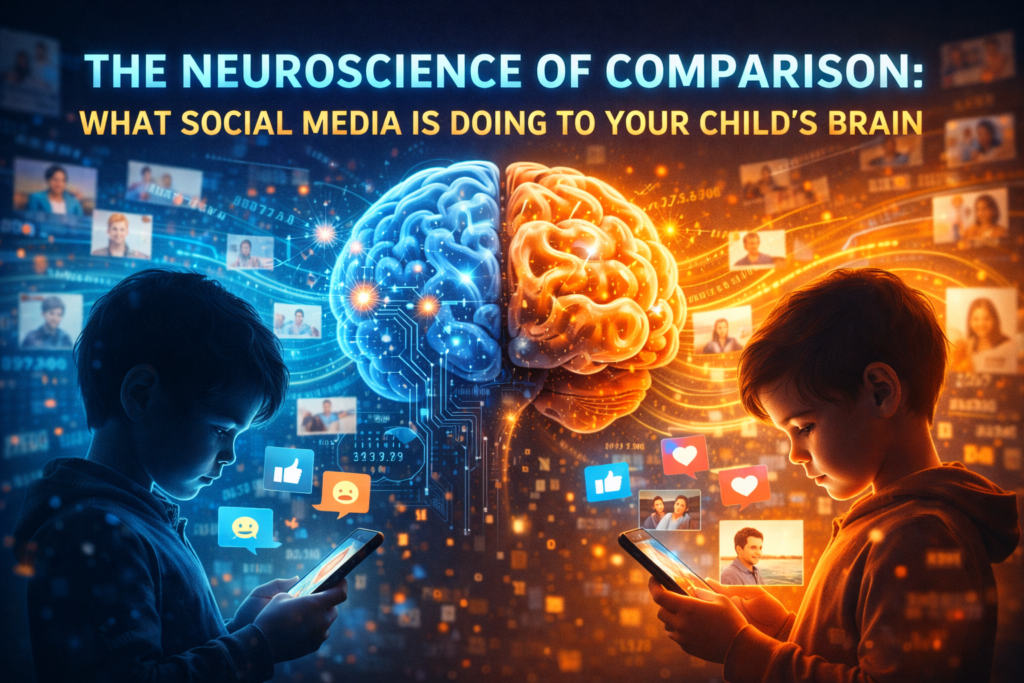
Scroll for five minutes and you’ll see it.
The perfect vacation.
The filtered faces.
The kids who look like they’ve never had a zit, a meltdown, or a bad grade.
And your child’s brain is absorbing it all — not passively, but biologically.
The Brain Behind the Scroll
You might think your child is immune because they roll their eyes at “cringe influencers.”
But here’s what neuroscience shows us: even when they joke about it, their brain is comparing. Every. Single. Time.
Why? Because the human brain is wired for social comparison.
It’s an ancient survival mechanism.
In the past, comparing ourselves helped us fit into the tribe — to know where we belonged and how to stay safe.
Today, the same circuitry fires not in a village, but on a screen filled with curated perfection.
Each scroll triggers the social evaluation network — involving the amygdala, ventromedial prefrontal cortex, and anterior cingulate cortex — areas designed to process social rank, approval, and threat.
The result?
Your child’s nervous system reacts as if their self-worth and belonging are on the line.
It’s not “just scrolling.”
It’s constant neurological measurement.
When the Brain Feels “Less Than”
Every like, every filtered image, every flawless “morning routine” hits the dopamine system — the brain’s reward circuit.
Dopamine isn’t just pleasure; it’s about anticipation of validation.
When your child doesn’t get the same “reward signals” others seem to have, their brain interprets it as social exclusion.
That triggers the same pain centers as physical rejection.
Over time, this shapes how their self-concept wires.
They start believing: “I’m smaller. I’m less.”
And when a child’s brain starts believing small, it acts small — avoiding risks, shying away from challenge, doubting its own worth.
The Silent Mirror
Imagine your child standing in front of a mirror while invisible voices whisper:
“Not good enough.”
“Not pretty enough.”
“Not popular enough.”
That’s not metaphorical.
That’s what’s happening neurologically.
Every comparison lights up the mirror neuron system — the same network that fires when we imitate or empathize.
But when that system keeps mirroring unrealistic perfection, it stops being empathy and becomes self-criticism.
So no — it’s not the phone itself that’s toxic.
It’s the chronic activation of stress and reward circuits designed for survival — now hijacked by algorithms built for attention.
What Can We Do?
You can’t bubble-wrap them or block the entire internet.
But you can give them something no algorithm ever will: neural protection through perspective.

Step 1: Teach Cognitive Decoding
When they say, “Look at her room — it’s so nice,” resist saying, “Don’t worry about that.”
That shuts down reflection.
Instead, activate their prefrontal cortex — the part responsible for reasoning and regulation — by asking:
✅ “Do you think she cleaned up before filming?”
✅ “How many takes do you think it took to get that clip?”
✅ “Do you think she ever has a bad day she didn’t post?”
Step 2: Change the Metrics
If social media measures beauty, popularity, and perfection, you measure effort, courage, and kindness.
This shifts the brain’s focus from external validation (dopamine-driven) to internal satisfaction (serotonin and oxytocin-driven).
Say things like:
✅ “You didn’t feel like going to soccer, but you still went — that’s grit.”
✅ “You didn’t win, but you didn’t quit either — that’s resilience.”
✅ “You were kind even when no one saw it — that’s strength.”
Each time you notice these invisible wins, you’re literally rewiring neural reward pathways to associate self-worth with effort, not applause.
Where Parents Often Go Wrong
We say things like:
❌ “Stop comparing yourself.”
❌ “Social media is stupid.”
❌ “You’re always on your phone.”
But the brain doesn’t stop caring because it was told to.
It stops when it’s given better information.
So instead of shaming, guide.
Name what’s happening in the brain: “That’s your comparison system lighting up — it’s normal, but you don’t have to believe it.”
When children learn to recognize their own brain patterns, they develop metacognition — the ability to think about their thinking.
That’s how emotional resilience is built.
The Reframe That Heals
The next time your child emerges from a scroll looking smaller,
don’t scold them — connect.
Remind them:
Nobody posts the mess.
Nobody uploads their fear.
Nobody filters their failures.
And then say:
“The things that matter most about you can’t be captured by a camera — because they live inside your brain, your heart, and your actions.”
When children begin to understand why comparison feels painful,
they stop personalizing it and start decoding it.
And once they see the trap through the lens of neuroscience —
humiliation loses its power.
The algorithm stops being magic.
And the brain starts remembering the truth:
They were never small. They were just human —
wired to belong, and ready to learn how to belong wisely.